
Effective January 1, 2012, a head and neck restraint system meeting either SFI 38.1 or FIA 8859 specifications will be mandatory in Sports Car Club of America (SCCA) Club Racing. Other racing sanctioning bodies including National Auto Sport Association (NASA) already have this requirement.
If you do not already have a system that meets this criteria, the question becomes which device should be purchased? Being in the market for a new system myself, I can tell you that getting actual facts about each device is far from straight forward. The reality of our decision is that there are only two manufacturers which make systems which comply with the certifications – HANS and Safety Solutions. In this article we’ll compare the Safety Solutions Hybrid Pro Rage, Safety Solutions R3 and HANS systems that OG Racing was nice enough to loan us. We will also touch upon some of the possible politics involved in the certification process that is supposed to protect us, the consumer.
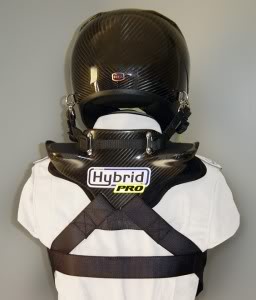
Safety Solutions Hybrid Pro Rage – $595 at OG Racing
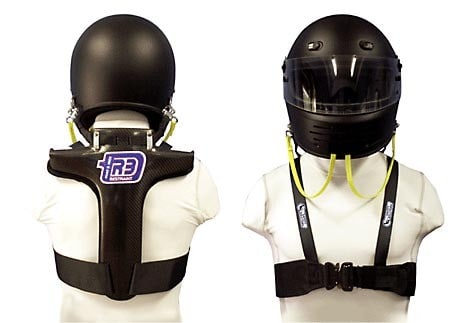
Safety Solutions R3 – $995 at OG Racing
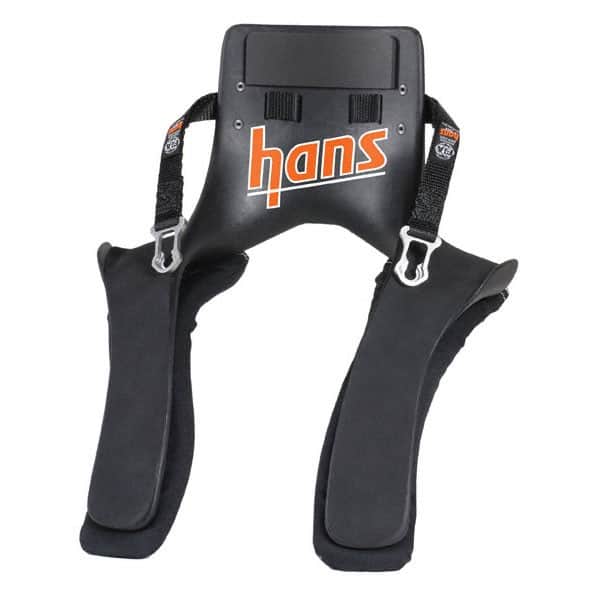
HANS Sport – as low as $515 at OG Racing
(We had the Sport II model, but would most likely buy the Sport I – see below video for explanation)
How the Models Compare in Crash Tests
While each of the models we reviewed are SFI 38.1 certified, we wanted to know which one performs better in both frontal and side impact testing. The HANS device is also FIA approved while the Hybrid Pro Rage is not. Correction: the Safety Solutions Hybrid has FIA approval. Many sites list the Hybrid Pro as having FIA approval, but it does not. Your initial thought might be to simply go to the SFI website to review the data. Look all you want but you won’t locate any test results. I found this puzzling and thought that I merely wasn’t going to the right place on their site, so gave them a call. The SFI representative told me that the crash test results are confidential information and it is not listed on their site, nor is it on the FIA website.
SFI recommended that we contact the manufacturers directly and ask them. They stated  that the purpose of SFI in relation to the 38.1 specification is to ensure that the products wearing the sticker conform to the certification criteria. The same can be said of FIA and their spec 8859. The reality of this certification process involves manufactures working directly with one of two labs, conduct the testing, then submit the results to SFI and FIA themselves. Do they take the one best test out of many, the median result, or even an average? It is up to the manufacturer to decide this but keep in mind it will also be used for marketing their products.
The HANS site lists their test results as well as the results of a Safety Solutions R3 which has since seen multiple reiterations since then which have better performance. I was unable to locate the Safety Solutions test results from the manufacturer, so I reached out to them directly. The below numbers represents information from the HANS site for their product as well as the information provided.
Upper Neck Tension at a 68G /Hit for the HANS and Safety Solutions Hybrid Pro Rage:
The lower the number, the better. The R3 does not yield as good test results as the Hybrid Pro Rage but Safety Solutions claims it still performs better than the HANS system. We were unable to obtain the R3 test numbers.
0 degrees (frontal impact)
HANS 210 lbs 934.1 Newtons
Safety Solutions 69 lbs 306.9 Newtons
30 degrees
HANS 494 lbs 2197.4 Newtons
Safety Solutions 22 lbs 97.9 Newtons
40 degrees
HANS 538 lbs 2393.1 Newtons
Safety Solutions 153 lbs 680.6 Newtons
Again, keep in mind these numbers are being supplied by each manufacturer. The neck tension numbers listed above are only one of the test results gathered. To fully compare the units, it would be necessary to know these numbers in addition to compression and NIJ (theoretical calculation based on neck loads). Good luck finding those results anywhere accessible to the public.
Some interesting observations:
- SFI is funded by companies which voluntarily participate in the specs program, along with financial support from member sanctioning bodies.
- Manufacturers pay the SFI for each unit they sell.
- SFI does not publish the actual test results. Instead you need to rely on what the manufacturer lists where they are also marketing their product.
- Dr. Robert Hubbard and IMSA driver Jim Downing developed the HANS device during the early 1980s. The first use of the product was on 11/30/86.
- SFI 38.1 certification was originated in 2004 and the developers of HANS were involved with writing the spec. Since HANS was a pioneer in head and neck restraint systems, it is somewhat understandable that the spec and device follow each other closely.
- Another head and neck restraint company by the name of DefNder entered into
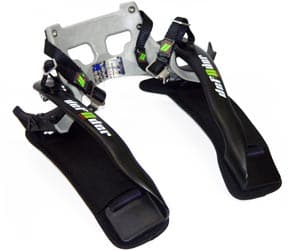 the industry, gained SFI certification, then was sued by HANS. DefNder no longer manufacturers their device. Arguments can be made upon HANS side that if they didn’t sue for patent infringement, they could have potentially lost their patent in the future. Of course they didn’t want to lose out on business, and maybe shouldn’t because they did the development on the product?
In my conversation with SFI, I commented about how limiting this certification design is and whether there are opportunities in the near future to modifying it’s language. They did state that the 38.1 spec is reviewed every other year by their committee, which I suppose is a step forward. Unfortunately the committee is also made of up of the manufacturers who have their product certified. What possible motivation would they have to open this spec up to allow for other designs? None that I can think of.
In the end, both units will provide more protection than nothing at all. To truly gain head and neck protection, the HANS unit requires a halo style seat and side triangular nets on either side of the seat. Safety Solutions claims this isn’t as critical with their products, but who knows the reality? For most of us Club Racers, it will most likely come down to personal preference on how each unit feels, pricing, and what we see others using.
Jake Gulick’s Feedback
It was an interesting experience, especially discussing the possible designs with an engineer who was a part of our group testing the systems. A fresh face to this, he had ideas, but each one ended up running afoul with the 38.1 Spec. He concluded, “If they’d spec the performance parameters, as opposed to the design parameters, we could see some innovation and some really cool products”.
Each product I tried had some issue. Each seemed a step back from what I had (an ISAAC system). The R3 fit me best.
The HANS rubbed my shoulders the wrong way, and it seemed that when I put my head forward to the limits of the straps, I went a long way further than the other deices. It felt like a dog on a chain when I did hit the limits. Actually hurt my forehead area. The straps were non adjustable unlike the Safety Solutions models. It made me think: “Various people have short necks, long necks and so forth, how does one size strap fit all?” The other ones had adjustable straps, and THAT made me think, what’s to stop me from adjusting this right out of spec?
Figuring out which of the units performs best isn’t obvious either. But I wondered, how will they perform on ME? If you can’t adjust the straps on one, you have to think that performance will vary depending on the user. You’d think it would have to, it’s all geometry, right? And vice versa.
None of them were what I’d call easy to hook up, except the HANS seemed fine, and I’d get it after a few practice runs. The R3 was second, but I think the D rings were fussy. The Hybrid thing though, jeeeez. the way the belts must sit and the proximity of the straps made it pretty tricky.
The obvious takeaway is “No new news” and that the HANS was the least annoying and the best of the bunch (ignoring my performance concerns), and that’s no surprise as they were involved in writing a very tight specification.
Greg’s Feedback
I’d go for the HANS. It fits better, (I assume) they “resolved” the issue with the belts sliding off, and the standard connections on the helmet are easy to use. Plus more and more helmets, like my Arai, already have the mounting points.
Hybrid – I noticed some pressure points on top the shoulders where the stitching is, but that may not as much an issue with Nomex underwear and a 3-later suit.
The pricier R3 seemed to fit OK, but I’d have concerns about how it would feel after three
hours in the car.
As much as it pains me to say it, were I buying something today then HANS would get the nod. They’ve been at it long enough, shouldn’t be any surprise they got it done best. In reality, I’ll keep using the older, crappier HANS because it costs me zero, and I’ll continue to be unhappy with it.
Jake F’s Feedback
The HANS system is what I’ll be buying.
If you’re wondering about the process to install one of these items, we’ve put together another video showing the general process. While I installed the mounts for the Safety Solutions system, the overall process is the same for the HANS mounts. Many helmets also now come with the HANS helmet mounts pre-installed. If you end up buying a helmet from OG Racing, they will complete the installation free of charge.
The above commentary is in no reflection of OG Racing’s view point. For any additional questions about the various units, related safety gear, or to purchase, contact OG Racing at 800.934.9112 and tell them we sent you their way.
Is the SFI 38.1 spec really so bad? Or does it do a good job ensuring the safety standards are met? Should the certification criteria be modified to allow for other designs, or do you think that could jeopardize the protection this process provides us? What other requirement criteria should clubs be using besides the SFI or FIA specs? If you have any of these systems, we’d also love to hear you feedback about them.
Updated Information:
Since this article was originally published, none other than Simpson Racing who owns the Safety Solutions H&NR brand, purchased the HANS brand as well. There has also been a new entrant to the H&NR market which meets SFI 38.1 approval – Necksgen. We have yet to test this system but looking at the product here, it sure looks similar to the HANS unit. Not much of a surprise there though now is it?